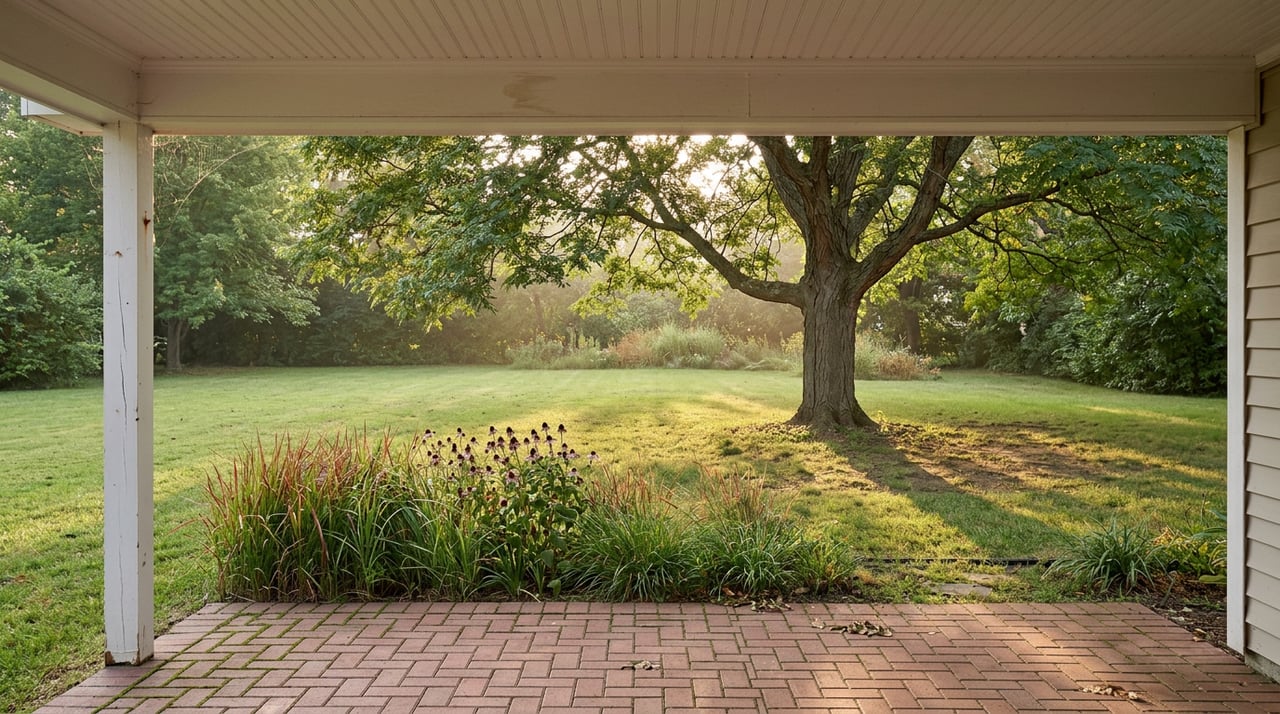
Drive north on Maize Road past the shopping centers and the drive-thrus and you will pass a stretch of land that does not look like it belongs there. No parking lot signage lit up at night, no manicured entrance, just a low gravel lot with 32 stalls and a paved path disappearing into grass taller than a mailbox. Most Westlink residents have driven by it a hundred times without stopping. Some assume it is undeveloped land waiting for its turn. It is not waiting for anything. It has been exactly what it is for over a century, and the reason it still looks the way it does has nothing to do with zoning and everything to do with one family's decision to leave it alone.
This is Swanson Park, and the story behind why it exists, and why the city burns it on purpose every winter, explains something about Westlink that the shopping center and the ranch houses do not.
A Homestead That Never Became a Subdivision
In 1874, a Swedish immigrant named Nels Swanson homesteaded 160 acres in what was then open country west of Wichita. His son Simon Peter Swanson, born in 1886, grew up on that land and eventually inherited it. Where most of the farmland around Wichita got broken, plowed, and eventually platted into the ranch-house grids that now define neighborhoods like Westlink, Simon Swanson took a different approach. He was known locally as a conservationist, someone who kept portions of his land in their natural state rather than converting every acre to row crops. That decision, made decades before "habitat preservation" was a phrase anyone used, is the reason a piece of untouched Kansas prairie and riparian woodland survived long enough to become parkland.
When the city acquired the property in 1975, it inherited not a blank lot but a genuinely old landscape, one that had never gone through the plow-subdivide-pave cycle that shaped everything around it. That is a different kind of history than a shopping center that opened in the late 1950s. It is land that opted out of the story Westlink otherwise tells.
Why This Park Looks Nothing Like Buffalo or Harvest
If you have spent time at Buffalo Park's splash pad or Harvest Park's pool, you know what a Westlink green space usually looks like: mowed turf, ball diamonds, tennis courts, a clear sense that someone maintains this for recreation. Swanson Park is managed for a different purpose entirely. It carries a Wichita Wild Habitat designation, one of only 15 such properties out of the city's 138 park sites, meaning the goal is not a manicured lawn but a functioning slice of native prairie, woodland, and wetland.
That distinction shows up in what the park allows and what it does not.
- A paved 1.33-mile nature trail loops through the property, open to walkers and leashed dogs
- Bicycles, motorcycles, skateboards, and blades are not permitted on the trail
- The lot off Maize Road holds 32 vehicles, no more
- Dogs must stay leashed the entire visit
None of these rules exist to make the park less convenient. They exist because the ground itself is doing ecological work that heavy wheels and off-leash traffic would undo.
The Smoke You've Smelled and Never Asked About
If you have ever caught a whiff of smoke drifting through Westlink sometime between January and March and wondered what was burning, there is a good chance the answer was Swanson Park, or one of the other 14 Wichita Wild sites getting the same treatment. The city's Park Maintenance staff conducts prescribed burns on these properties during that window every year, and the reasoning is not aesthetic. Fire is how native prairie has always managed itself. It clears the buildup of dead plant material that blocks sunlight from reaching new grass, it returns nutrients to the soil, and it knocks back the invasive species, Johnson grass, garlic mustard, bush honeysuckle, and eastern red cedar, that would otherwise choke out the native tallgrass over a few seasons.
This is the detail most neighbors miss entirely. A blackened field in February looks like neglect if you do not know what you are looking at. It is actually the opposite: a deliberate, annual act of upkeep that costs the city labor and coordination every single year to keep 93 acres from turning into scrub and cedar thicket. Skip the burn a few years running and the prairie disappears, replaced by whatever aggressive non-native plant gets there first. Westlink's quietest park stays wild only because the city keeps intervening to make it look untouched.
What You Actually Find When You Walk It
The trail itself is unremarkable in the best way. It is flat, paved, and shaded in stretches by riparian woodland, a term for the tree cover that grows naturally along water. Walkers report deer tracks pressed into the dirt shoulders, herons and egrets working the wetter sections, and enough birdlife, cardinals, blue jays, red-winged blackbirds, that a slow lap can turn into forty minutes without noticing. The land was developed in part using Land and Water Conservation Funds from the Kansas Department of Wildlife and Parks and the National Park Service, which explains why the trail feels built to a standard rather than thrown in as an afterthought.
What changes is the season. Late summer into early fall is when the prairie sections do the most visible work, tall native grasses catching low light in a way that a mowed park never will. Winter looks stark, especially in a burn year, but that starkness is temporary and purposeful. Spring brings the green back fast, feeding off nutrients the fire put back into the ground months earlier.
None of this requires a car ride out of the neighborhood. Swanson Park sits inside Westlink's own western boundary along Maize Road, a few minutes from the Central Avenue corridor most residents already drive daily for groceries or gas.
The Thing Worth Knowing
Westlink is a neighborhood built almost entirely in the 1960s, a place where the housing stock, the shopping center, and even the street layout all trace back to the same decade of rapid suburban growth. Swanson Park is the one piece of ground that skipped that story. It was never platted, never developed, never converted to lawn. It survived because one man in the early 1900s decided some land was worth leaving as it was, and because the city has kept making that same decision every winter since 1975 with a drip torch and a burn crew.
That is not a detail you get from a park brochure. It is the reason the 93 acres off Maize Road feel different from every other green space in the neighborhood, and it is worth knowing the next time you catch smoke on the wind in February or decide the paved loop deserves a slower lap than usual.
If you are a longtime Westlink resident thinking about what comes next for your own piece of the neighborhood, whether that means selling the house you raised a family in or figuring out what a move actually costs in a market that shifts by the block, Nancy Jo Statton has spent 37 years learning what makes this part of Wichita tick, right down to the land that never got developed. Let's Connect.